
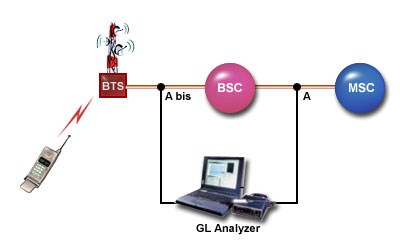
GSM protocol analyzer
Overview
GL’s GSM Analyzer is used to analyze GSM protocols, a switching and signaling telecommunication protocol between MSC & BSC, BSC & BTS, MSC & SMLC, UMA & MS,. and so on. GSM analyzer also supports decoding proprietary ‘Mobis’ Interface (Motorola equivalent of the GSM A-bis interface) with additional license XX151 between BSC (Base Station Controller) – BTS (Base Transceiver Station) and BSC (Base Station Controller) – PCU (Packet Controller Unit).
Other interfaces supported include Ls / Lb / Lp Interface (Interface between MSC and SMLC), and Up (Interface between UNC (UMA network controller) and MS).
HDLC frames are parsed according to Q.921, SS7 information parsing is based on ANSI and ITU standards: T1.111, T1.112, T1.113, Q.703, Q.704, Q.708, Q.723, Q.763 & GSM information parsing is based on 3GPP TS 08.08¸ 3GPP TS 24.008, 03.40, 3GPP TS 04.11, 3GPP TS 08.58, 3GPP TS 04.18. MTP2 is parsed according to ANSI-ITU standards and the higher GSM layer information parsing depends on the user’s selection of GSM 900, DCS 1800 & PCS 1900 according GSM variants.
GL Communications supports the following types of GSM analyzers:
- Real-time GSM Analyzer (Pre-requisites: GL’s field proven E1 or T1 internal cards or USB Laptop E1 or T1 external units, required licenses and Windows XP (or higher) Operating System)
- Offline GSM Analyzers(Pre-requisites: Hardware Dongles and Windows XP (or higher) Operating System)
In addition the following GSM applications are supported that further help in emulating GSM protocol over A & Abis interfaces:
GL’s GSM Protocol Analyzer supports complete analysis, decode and monitoring of GSM-R (GSM-Railway) – an international wireless communications standard for railway communication and applications. For more information, click on GSM-R Analyzer.
GSM Analyzer Main Features
- Interfaces supported are A (Interface b/w BSC and MSC), A-bis (Interface b/w BSC and BTS), Mobis (Motorola Proprietary Interface b/w BSC and BTS and also b/w BSC and PCU), Gs (Interface between SGSN and MSC), Ls / Lb / Lp Interface (Interface between MSC and SMLC), Up (Interface between UNC (UMA network controller) and MS).
- Displays Summary, Detail, Hex-dump, Statistics, and Call Trace Views, the contents of this view can also be copied to clipboard.
- Summary View displays MTP2, MTP3 information, GSM Message types, information about various channels used during the call, frequency hopping and so on in a tabular format.
- Detail View displays decodes of a user-selected frame from the Summary View.
- Decoding of many RR layer non-transparent messages such as “System Information”, “Measurement Result”, “Immediate Assignment” etc.
- Statistics View displays statistics based on frame count, byte count, frames/sec, bytes/sec etc for the entire captured data.
- Call Detail View displays call statistics such as number of active/completed calls, durations of the completed calls, Type of Call (e.g. SMS/Location Update/Authentication/Speech Call), IMSI/TMSI associated with each call.
- Call Detail Recording feature includes data link groups that help in defining the direction of the calls in a given network and form logical groups comprised of unidirectional (either ‘Forward’ or ‘Backward’) data links.
- Hex dump view displays raw frame data as hexadecimal and ASCII octet dump, the contents of this view can also be copied to clipboard.
- Search and filtering capabilities.
- Exports Summary View information to a comma delimited file for subsequent import into a database or spreadsheet.
- Capability to export detailed decode information to an ASCII file.
- Any protocol field can be added to the summary view, filtering, and search features providing users more flexibility to monitor required protocol fields.
- Remote monitoring capability using GL’s Network Surveillance System.
Additional features supported by real time GSM analyzer are
- Streams can be captured on the selected time slots (contiguous or non-contiguous), sub-channels or full bandwidth.
- Real-time filtering based on the frame length.
- Supports decoding of frames with FCS of 16 bits and 32 bits, or none.
- Recorded trace files can be played back using HDLC Playback application.
- Multiple streams of GSM traffic on various T1/E1 channels can be simultaneously decoded with different GUI instances.
- Frames can be transmitted or captured in either, n x 64 kbps, or n x 56 kbps data channels.
- The variations accommodated in the software are inverted or non-inverted data, and byte reversal or non-reversal.
Additional features supported by Offline GSM Analyzer:
- Trace files for analysis can be loaded through simple command-line arguments.
- Multiple trace files can be loaded simultaneously with different GUI instances for offline analysis.
Supported Protocols:
The supported protocol interfaces in GSM analyzer are A-Interface, Abis-Interface, Gs-Interface, Up-Interface, Lb,Ls,Lp-Interfaces, Mobis Interface.
- A Interface (variants GSM 900, DCS 1800, PCS 1900) – MTP2, MTP3, SCCP, BSSMAP, MM, CC, SMS, GCC, BCC, DTAP.
- Abis Interface (variants GSM 900, DCS 1800, PCS 1900) – LAPD, BTSM, RR, MM, CC, SMS, GCC, BCC .
- Gs Interface (variants GSM 900, DCS 1800, PCS 1900) – MTP2, MTP3, SCCP, BSSAP+.
- Lb, Ls, Lp Interface – RRLP, BSSLAP, SMLCPP, LLP, BSSAP-LE (BSSMAP-LE/DTAP-LE), SCCP, MTP3, MTP2.
- Up Interface – UMA protocols, TCP, UDP, IP, MAC.
- Mobis Interface (requires additional license) – Mobis, LAPD, RR, MM, CC, SMA, GCC, BCC
GSM-R Protocol Analyzer
GSM-R is a proven mobile communications standard of ERTMS (European Rail Traffic Management System), the European standard for railway operations. It is used to carry railway-specific voice and data services. It is an extension of the standard GSM signaling protocol and uses frequencies specifically reserved for railway operations.
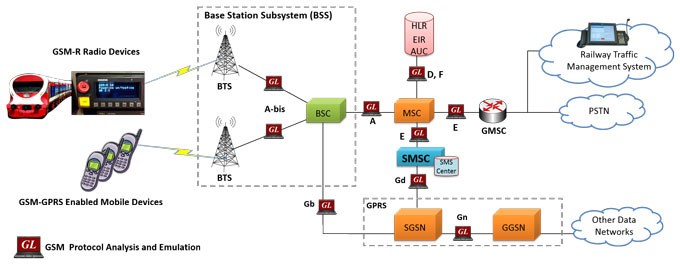
GSM Protocol Analyzer adds GSM-R features such as VGCS, VBS, eMLPP, Emergency numbering and Functional numbering etc. GSM Protocol Analyzer also adds an User to User Information IE to GSM CC, BCC and GCC protocols to support GSM-R features according to EIRENE specification (H 22 T 0001 2) and ETSI TS 102 610. A GSM-SS layer decode is also added to existing GSM protocol stack to support all the Supplementary Services.
GSM-R Services supported by GL’s GSM Analyzer
- Alerting of a Controller (User-to-User Signaling – UUS)
- Presentation of a Functional Number – UUS
- Multi driver Communication – (Multi Party – MPTY)
- Registration and Deregistration of Functional Numbers – (Unstructured Supplementary Services Data – USSD)
- DSD Alarm Notification – UUS
- Enhanced Location Dependent Addressing – UUS
- Shunting – MPTY, SCD, VGCS, FA
- Functional Addressing – Follow Me
- Confirmation of High Priority Calls – UUS
- Railway Emergency Calls – MPTY
- Voice Broadcast Service (VBS)
- Voice Group Call Service (VGCS)
- Enhanced Multi-Level Precedence & Pre-emption (eMLPP)
- Line identification services like CLIP, CLIR etc
- Call Forwarding, Call Waiting, and Call Hold
- Closed User Group
- Advice of Charge
- Call Barring and Call Deflection
- User-to-user signaling
- Follow Me (Based on USSD and CF)
- Location Services, USSD and more
Typical Users
- Railway operators
- Railway system integrators
Typical Applications
- Complete end-to-end surveillance of the GSM-R Network
- Surveillance of specific tracks and high speed lines
- Roll-out, and verification railway specific applications