
Network Surveillance System
Overview
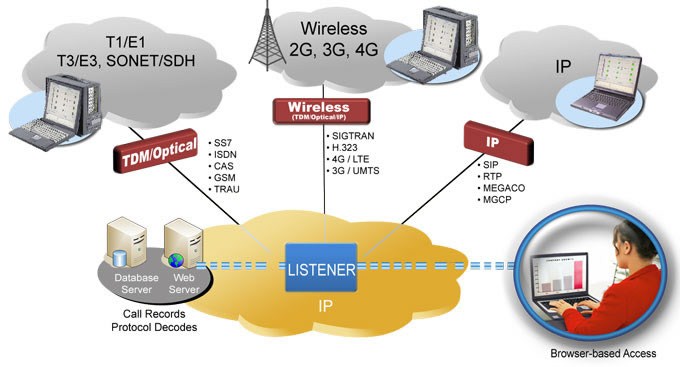
Any network operator, service provider, or equipment manufacturer must have the means to perform the capture and surveillance tasks remotely, automatically, and non-intrusively. Fortunately, the network backbone contains a wealth of information that can be monitored and collected to support these activities.
GL’s Network Monitoring and Diagnostic Systems are web-based applications that facilitate display of CDRs by connecting to TDM, Optical, or IP probes through a web server for monitoring physical layer, signalling and traffic. Currently supported protocols include SIP, VoIP (SIGTRAN, SIP, H.323), SS7, ISDN, GSM, TRAU, and MAP. Support for additional protocols – IuCS, IuPS, LTE, and GSM A are coming soon.
GL’s current NMS solutions using NetSurveyorWeb™ for VoIP and TDM networks are outline below:
- IP Network Monitoring and Surveillance System (passive / non-intrusive) – SIP, RTP, H.323, SIGTRAN, MAP
- Wireless Network Monitoring and Surveillance System (passive / non-intrusive) – GSM, UMTS, LTE, Diameter, IMS
- TDM and Optical Network Monitoring and Surveillance System (passive / non-intrusive probes) – SS7, ISDN, GSM Abis, TRAU
- Digital T1 / E1 Line Monitoring, Test, and Diagnostic System
GL’s NetSurveyorWeb™ is based on a scalable and flexible architecture and is used in conjunction with GL’s Protocol Analyzer probes to non-intrusively monitor from one or many testing locations. GL’s protocol analysis probes feed data to centralized database (Oracle) in real-time for further analysis. The NetSurveyorWeb™ client application then locally or remotely facilitates to view records from the database using a simple web browser application.
Typical Applications
- Comprehensive analysis from overall network health to detailed protocol monitoring
- Call Detail Records, fraud detection and location, remote protocol analysis and troubleshooting, real-time signaling monitor, traffic optimization engineering, and statistics.
- Determine actual call signaling routes to verify network functionality under all situations including congestion and loss of SS7 nodes.
- Revenue and billing verification, alarm monitoring, intrusive testing.
- Quality of service measurements, call trace and recording.