
MAPS™ UMTS for IuCS, IuH Interfaces Emulator
Overview
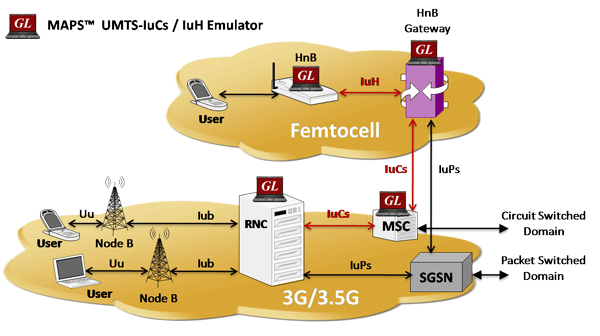
IuCS and IuH over IP
GL’s Message Automation & Protocol Simulation (MAPS™) designed for UMTS IuH interface can simulate Femto Home Node B (HnB), and a Femto Home Node Gateway (HnB-GW) by generating RANAP and DTAP signaling messages over SCTP Transport layer. A femtocell is a small cellular base station designed for use in residential or small business environments. Femtocells can offload the RAN and provide better coverage, plus improved data download & upload speeds. IuH links Femto Access Point (HnB) and a Femto Gateway (HnB-GW).
MAPS™ UMTS IuCS can emulate the RNC (Radio Network Controller) and the MSC (Mobile Switching Centre) by generating RANAP and DTAP signaling messages over SCTP. It includes ready scripts to simulate Location Update, Call Control MO (Mobile Originating), and Mobile Terminating (MT) procedures.
The application gives the users the unlimited ability to edit messages and control scenarios (message sequence). “Message sequences” are generated through scripts. “Messages” are created using message templates.
The application is available as
- MAPS™ – IuCS and IuH (Item # PKS160)
With the purchase of RTP Core license (PKS102), MAPS™ IuCS supports transmission and detection of various RTP traffic such as, digits, voice file, single tone, dual tones, IVR, FAX*, and Video*. With regular RTP traffic, the maximum Simultaneous Calls up to 2500, and Calls per Second up to 250 is achievable. Almost all industry standard voice codec supported.
GL’s MAPS™ IuCS is also available in High Density version (requires a special purpose network appliance and PKS109 RTP HD licenses). This is capable of high call intensity (hundreds of calls/sec) and high volume of sustained calls (tens of thousands of simultaneous calls/platform).
MAPS™ IuCS emulator also supports Iu-UP (Iu User Plane Interface) protocol layer of the Radio Network with additional licensing (PKS103) to carry RTP traffic (AMR payload part) over Iu interface in support mode of operation for predefined SDU size.
MAPS™ IuCS ATM
GL’s LightSpeed1000™ hardware platform (PCIe Card) with quad optical ports supports simulation of UMTS IuCs interface over ATM layer using MAPS™ IuCS ATM. The LightSpeed1000™ comes with software for overall monitoring, protocol analysis and emulation, and bert. The hardware can also be easily configured / programmed for delaying of ATM Cells or PPP packets.
MAPS™ IuCS ATM uses SSCOP server for establishing SSCOP links over which RANAP, ALCAP, and DTAP signaling will be carried for making calls. SSCOP Server is a GL’s WCS based server module that provides SSCOP, AAL5 and AAL2 layer services. Following licenses are required for MAPS™ IuCS ATM:
- OC3 / STM1 MAPS UMTS IuCS over ATM, requires (Item # LTS220)
- OC3 / STM1 SSCOP Server (Item # LTS214)
- OC3 / STM1 AAL2 Traffic Core (Item # LTS217)
Over successfully established call, traffic can be generated. MAPS™ IuCS ATM internally uses AAL2 Traffic Generator for traffic generation. Various traffic types like Tone, Digits and File playback are supported.
Main Features
- Simulates RNC, MSC, Home NodeB (HnB) and Home NodeB Gateway (HN GW) entities.
- Generates and process all Mobility Management, Session Management, RANAP, ALCAP, and DTAP messages over SSCOP.
- User controlled access to RANAP, and DTAP signaling messages over SCTP.
- Ready scripts for Mobile Originating, Mobile Terminating, Location Updating procedures for quick testing
- Supports RAB Assignment, Authentication, TMSI Reallocation, Encryption, and other optional procedures
- SSCOP links over which RANAP and ALCAP signaling will be carried further for making calls
- SSCOP Server (GL’s WCS based server module) provides SSCOP, AAL5 and AAL2 layer services
- Supports various traffic types including Tone, Digits and File playback over AAL2
- Supports traffic over Iu UP protocol layer and also over normal RTP sessions (requires additional licenses).
- All Codec supported including – G.711, G.711 App II with VAD, G.729, G.726, G.726 with VAD, GSM, AMR NB and WB, EVRC, SMV, iLBC, SPEEX NB and WB, G722, and G722.1. Visit Voice Codecs webpage for more comprehensive information.