
LTE (Long Term Evolution) Protocol Analyzer
Overview
The LTE (Long Term Evolution) protocol standard was developed as an enhancement to existing Universal Mobile Telecommunications System (UMTS) to provide users enhanced mobile Internet access. The evolved Universal Mobile Telecommunications Service (UMTS) terrestrial Radio Access Network (RAN), abbreviated as E-UTRAN, is also known as LTE.
GL’s LTE analysis is an optional module available with PacketScan analyzer (PKV100) with additional licensing (PKV107).
Although an evolution of UMTS (UMTS uses wideband code-division multiple access (WCDMA) for transmitting signals), the LTE air interface is a completely new system based on orthogonal frequency-division multiple access (OFDMA) in the downlink and single-carrier frequency-division multiple access (SC-FDMA) (DFTS-FDMA) in the uplink that efficiently supports multi-antenna technologies (MIMO). This robust feature is useful when handling the varying propagation conditions seen in mobile radio. In MIMO techniques, either multiple antennas can transmit the same data stream to improve data-transmission reliability or different antennas can transmit different data streams simultaneously to increase throughput.
Another significant feature of LTE is its high bandwidth—up to 20 MHz. Because the usable bandwidth is scalable, LTE can also operate in the existing 5-MHz UMTS frequency bands, or in even smaller bands.
Network Architecture
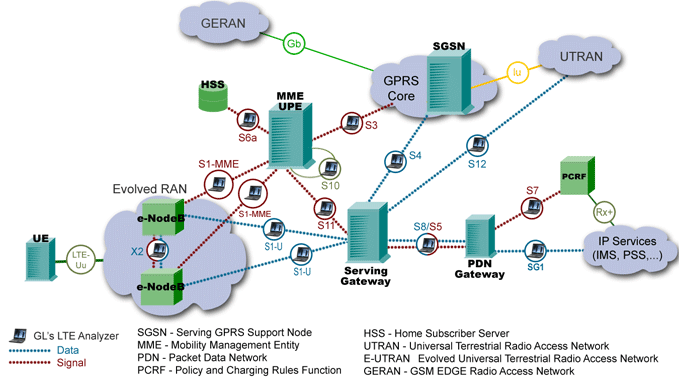
LTE standard is progressing as a part of 3rd Generation Partnership Project (3GPP). The Evolved Packet System (EPS) standardized by 3GPP is divided into a radio access network known as the E-UTRAN and a core network known as the Evolved Packet Core (EPC). The E-UTRAN consists of eNodeBs, which provide the radio interface toward the user equipment. The eNodeBs are interconnected with each other via the IP-based X2 interface and toward the Evolved Packet Core (EPC) via the IP-based S1 interfaces. This is depicted in the above figure.
GL’s LTE analyzer is capable of capturing, decoding and performing various test measurements across various interfaces i.e. S1, S3, S4, S5 (or S8), S6a, S10, S11, S13 and X2 interfaces of the LTE network.
GL Communications supports both Real-time and Offline types of LTE Analyzer. Required pre-requisites are – Hardware Dongles and Windows® 2000/XP/Vista Operating System.
Main Features
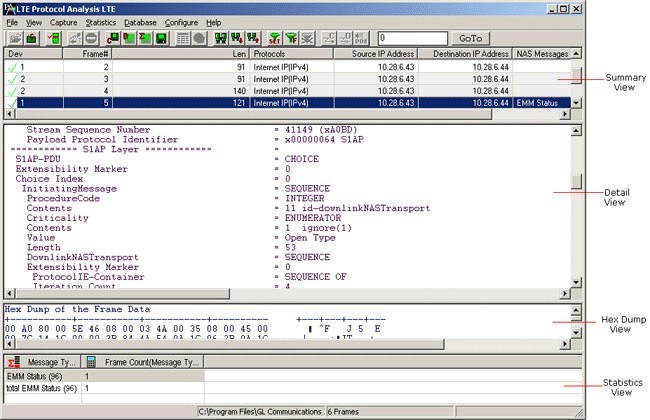
- Displays Summary, Detail, Hex-dump, Statistics, and Call Trace Views, the contents of this view can also be copied to clipboard.
- Detail View displays decodes of a user-selected frame from the Summary View.
- Statistics View displays statistics based on frame count, byte count, frames/sec, bytes/sec etc for the entire captured data.
- Hex dump View displays raw data as a hexadecimal and ASCII octet dump the contents of this view can also be copied to clipboard.
- Search and filtering capabilities.
- Exports Summary View information to a comma delimited file for subsequent import into a database or spreadsheet.
- Capability to export detailed decode information to an ASCII file.
- Any protocol field can be added to the summary view, filtering, and search features providing users more flexibility to monitor required protocol fields.
- Remote monitoring capability using GL’s Network Surveillance System.
Additional features supported by Offline LTE Analyzer
Trace files for analysis can be loaded through simple command-line arguments.
Multiple trace files can be loaded simultaneously with different GUI instances for offline analysis.
Supported Interfaces & Protocols:
GL’s LTE analyzer is capable of capturing and decoding various interfaces i.e. S1, S3, S4, S5 (or S8), S6a, S10, S11, S13 and X2 interfaces of the LTE network. The protocols supported for decoding across all these interfaces are NAS, S1AP, X2AP, eGTP, GTP-U, Diameter, SCTP, UDP, TCP, IP.
| Supported Protocols | Specification Used |
|---|---|
| MAC | IEEE 802.3 |
| IP | RFC 791 |
| UDP | RFC 768 |
| SCTP | RFC 2960 |
| S1AP | 3GPP TS 36.413 V9.0.0 |
| X2AP | 3GPP TS 36.423 V9.0.0 |
| eGTP | 3GPP TS 29.274 V8.0.0 |
| NAS | 3GPP TS 24.301 V9.0.0 |
Network-wide Monitoring & Troubleshooting of LTE Networks
GL’s Network Monitoring System (NMS) with LTE Analyzer provides a complete tool set to monitor LTE networks. The system provides scalable, centralized, real time, end-to-end network visibility and trouble-shooting capability for operators deploying LTE networks.