
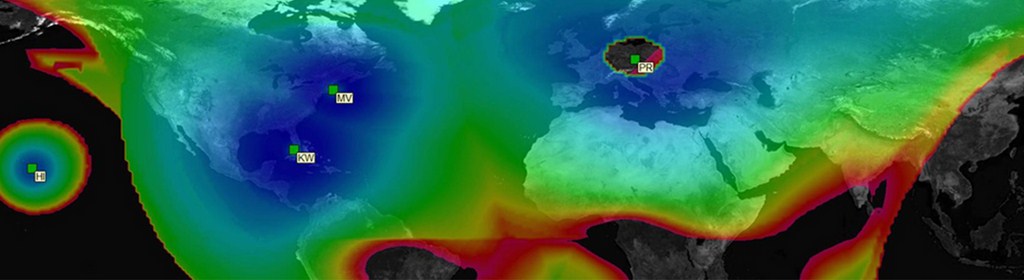
Spectrum-E Is ATDI’s Latest Mobile Planning And Modelling Solution. Spectrum-E Is A Web Application Which Works On IPad, Android Tablet, A Smartphone Or A Desktop.
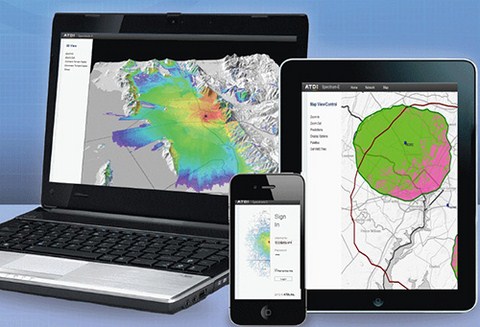
Spectrum Engineering is now online! ATDI’s new RF network planning and analysis web application adds another dimension to the classic ATDI product line of desktop-based software solutions. Spectrum-E© is ATDI’s tablet-friendly web application for planning telecommunication networks and performing frequency nomination analyses for government and commercial networks operating in the MF through UHF bands. Customers can select from different templates specific to their technology of interest. Custom templates can be prepared per request based on the types of analysis required.
Spectrum-E© offers the ultimate in mobility for those seeking RF modeling capabilities in the field and on the go. With an HTML5-capable web browser (be it on a tablet, computer, or smartphone) and an internet connection (be it over Wi-Fi, a cellular network, or a LAN connection), the Spectrum-E© user can produce accurate and timely results in almost any environment.
By connecting to ATDI’s dedicated Data Center, ATDI customers can perform various engineering simulations such as a multi-station composite coverage analysis over high-resolution terrain and clutter, frequency nomination analysis, and interference studies; all within a minute each! Below are some examples of the features available in Spectrum-E© for different radio technologies:
Land Mobile Radio
- Automated import from the FCC ULS databases
- Region 8/55 analysis (US LMR)
- FCC Safe Harbor Calculations
- FCC [50,50] and [50,10] contour generation for VHF/UHF LMR and automatic overlap analysis
- HAAT and DHAAT calculations
- Talk-out and talk-in coverage analysis using multiple propagation models including Longley-Rice, Okumura-Hata-Davidson and ITU-R P.1546
- Automated service area reliability degradation analysis and reporting between proposed stations and co-and adjacent channel incumbent stations per TSB.88-C
- Automatic frequency plan ranking and availability for purposes of frequency nomination
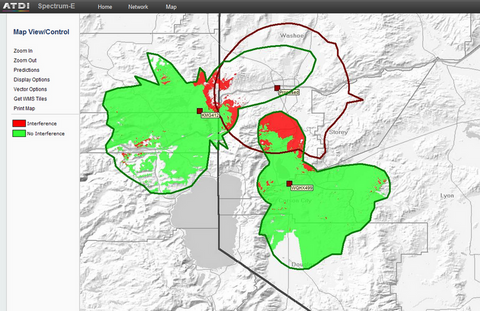
AM/FM and Television Broadcast
- Automated import from the FCC CDBS database
- Service area contour analysis for AM broadcast stations per ITU-R P.1147-4 considering day/night coverage
- FCC [50,50] and [50,10] contour generation for VHF/UHF broadcast and automatic overlap analysis
- HAAT calculations
- Propagation analyses of digital signals in the VHF/UHF bands using ITU-R P.1546-4 and ITU-R P.1812-2
- Automated interference analysis and reporting between proposed and incumbent FM broadcast stations per ITU-R BS.412-9
- Automatic frequency plan ranking and availability for purposes of frequency nomination
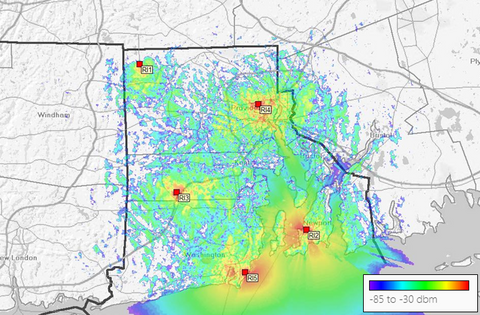
Microwave
- Automated import features from the FCC ULS databases
- Point-to-point link reliability and path profile reporting using ITU-R P.530-12
- Automated interference analysis and reporting between proposed and incumbent microwave links per TSB.10-F
- Automatic frequency plan ranking and availability for purposes of frequency nomination
Air Navigation Systems
- Radar line-of-sight coverage according to ITU-R P.525-2
- FAA Service Order 6820.10 Clearance Contour generation
- Minimum Safe Distance Clearance Contour generation for navigational aids (VOR, DME, TACAN)
Wind Turbines
- Siting analysis for Wind Turbine proposals
- Worst Case Fresnel Zone analysis against microwave links
- Automated import features from the FCC ULS and CDBS databases
HF Systems
- Skywave and groundwave propagation simulation based on ITU-R P.533-10 and ITU-R P.368-9
- Point-to-point skywave signal-to-noise plots
- Percentage of day covered coverage prediction type
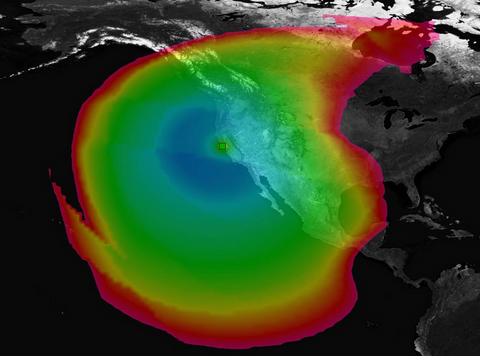
Additional features include but are not limited to:
- Customizable 2D prediction displays
- 3D terrain view with vector and prediction overlay
- Percent coverage analysis
- SHP vector import and coverage carving
- Downlink coverage overlap reporting
- Report template editing features
- Skywave and Groundwave propagation simulation based on ITU-R P.533-10 and ITU-R P.368-9
Web application advantages:
Web applications offer specific advantages over local software applications in the following areas:
- Consumption of client computer resources: zero footprint implementation. (i.e. SSL access)
- Cross platform compatibility: Operating system agnostic. Runs off of modern browsers. (i.e. tablet or PC or smartphone)
- Ease of distribution of information: database information can be communicated to large groups of people very quickly and easily. (i.e: multi-resolution map databases, relational databases, equipment databases, etc.)
- Customization and integration-friendliness: Work flow automation with dedicated interfaces. (i.e. import FCC ULS, WMS stream, integration with SpectrumWatch)
- Maintenance: Upgrade distribution is immediate.
Spectrum-E© is compatible with any HTML5 compatible web browser (Google Chrome, Mozilla Firefox v9+, IE v9+, Safari, Opera). Google Chrome is recommended for the best Spectrum-E© experience. Spectrum-E© is a tablet-friendly web application.
Access to Spectrum-E©
Access to Spectrum-E© can be delivered in any of the following methods:
- User Subscription: Customers will subscribe to access of Spectrum-E© hosted on ATDI Inc’s servers
- Local Area Network (LAN): Spectrum-E© and services installed on customer’s internal network
- Single Computer:, Spectrum-E© can be installed on an individual user’s computer